Chandigarh
The City That Was Drawn First
“Every other Indian city grew and then argued about the plan. Chandigarh argued about the plan first — and then a road inspector smuggled in the argument's answer.”
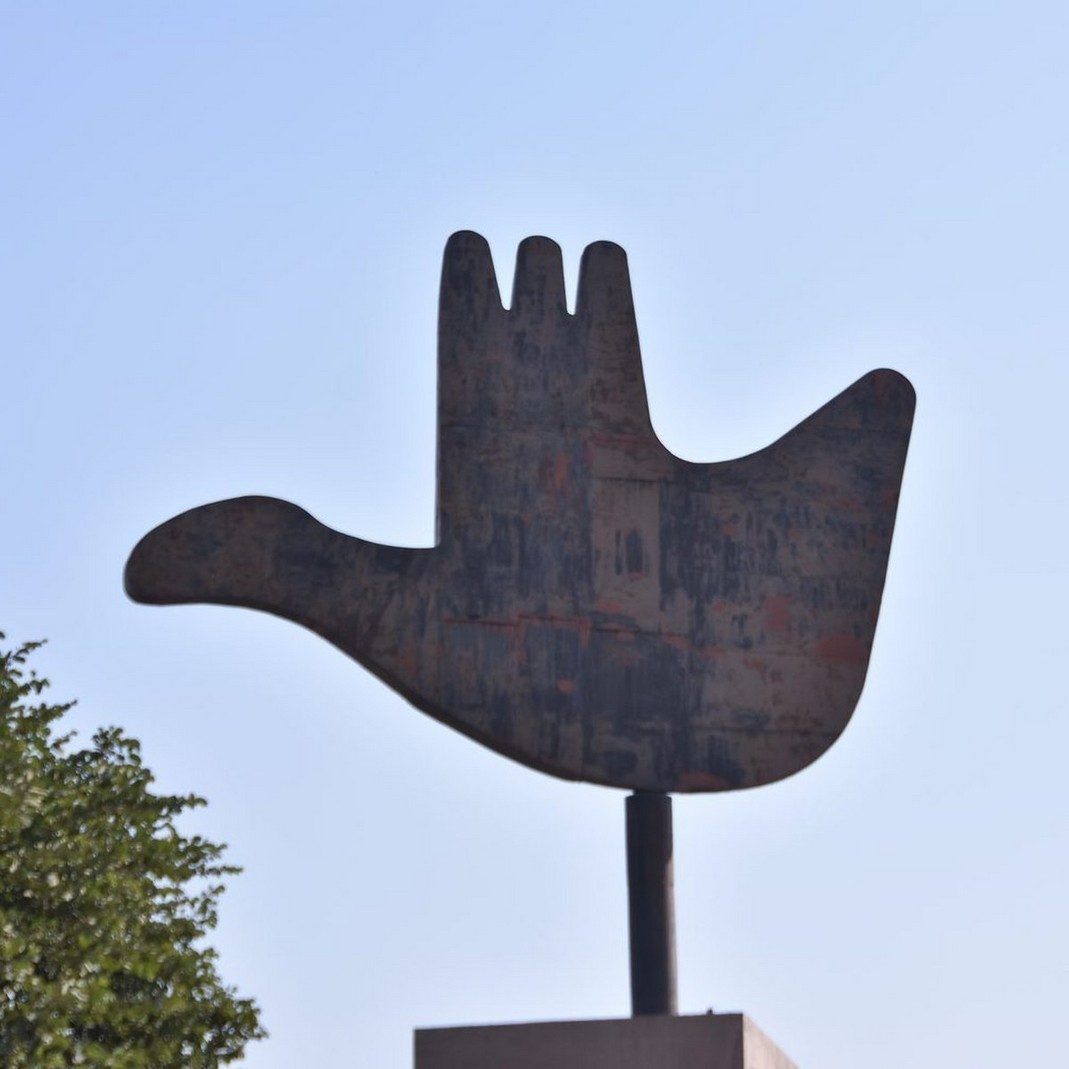
Photo: shankar s. from Poona (pune), India / Wikimedia Commons (CC BY 2.0)
A City with No Ancestors
After months of travelling through cities that were essentially archaeological sites with traffic, Chandigarh promised a novelty I could barely picture: a major Indian city with no old quarter, no medieval gate, no layer beneath the layer, because there is no beneath. Chandigarh was willed into existence in the 1950s, on farmland below the Shivaliks, for the bluntest of reasons: Partition had given Punjab's beloved capital, Lahore, to the other side of the border, and the wounded state needed a new head. Nehru wanted more than a replacement; he wanted a statement, a city, in his phrase, unfettered by the traditions of the past, a symbol of the nation's faith in the future. The commission wound its way to the Swiss-French modernist Le Corbusier, who arrived with a fountain pen and a doctrine, and drew, sectors like a grid of garden villages, a hierarchy of roads, a 'head' of government buildings against the hills, green belts running like veins. I arrived by morning bus from Haryana into Sector 17, and the first sensation was almost vertiginous: roundabouts that worked, trees in disciplined avenues, signboards in a single typeface. My rickshaw driver watched me gawking at the tidiness and diagnosed me instantly: 'First time? Everyone looks like that. Don't worry, we are still Indian. Go to the vegetable market, you will feel at home.'
It is the only politician here that changes direction honestly, only with the wind that everyone can see.From the chapter
The Concrete Parliament of Light
The city's 'head', the Capitol Complex, now a UNESCO World Heritage Site as part of Corbusier's transnational listing, requires a permit and a guided slot, and rewards both. Here the architect built his civic trinity in raw board-marked concrete: the High Court under its parasol roof of giant painted piers; the Secretariat's long cliff of offices; and the Assembly, whose hyperbolic funnel roof (borrowed, Corbusier admitted, from the cooling towers of Ahmedabad's power stations) pours a shaft of managed daylight onto the legislature below. Between them, esplanades scaled for a republic and, on its plinth, the Open Hand: a giant metal hand-cum-dove, twenty-six metres with its mast, turning freely with the wind, the city's official emblem and Corbusier's chosen message, open to give, open to receive. Our small tour group stood beneath it as it swung ponderously through a quarter-turn, and the guide delivered the complex's best line with practised timing: 'It is the only politician here that changes direction honestly, only with the wind that everyone can see.'
The chapter continues in the book…
- AnticipationA City with No Ancestors
- ArrivalThe Concrete Parliament of Light
- ExplorationLife Inside the Grid
- DiscoveryThe Smuggled Kingdom
- Traveller's NotebookChandigarh Essentials
- FarewellThe Correction in the Gorge
Chandigarh, from the road

Read Chapter 22 in full
The complete Chandigarh chapter — with when to go, getting around, what things cost, what to eat and how to travel responsibly — is in 28 Shades of India.