Meghalaya
The House of Rain
“Elsewhere, people build bridges and hope they last. In Meghalaya, they plant them — and the bridges spend a hundred years getting stronger.”
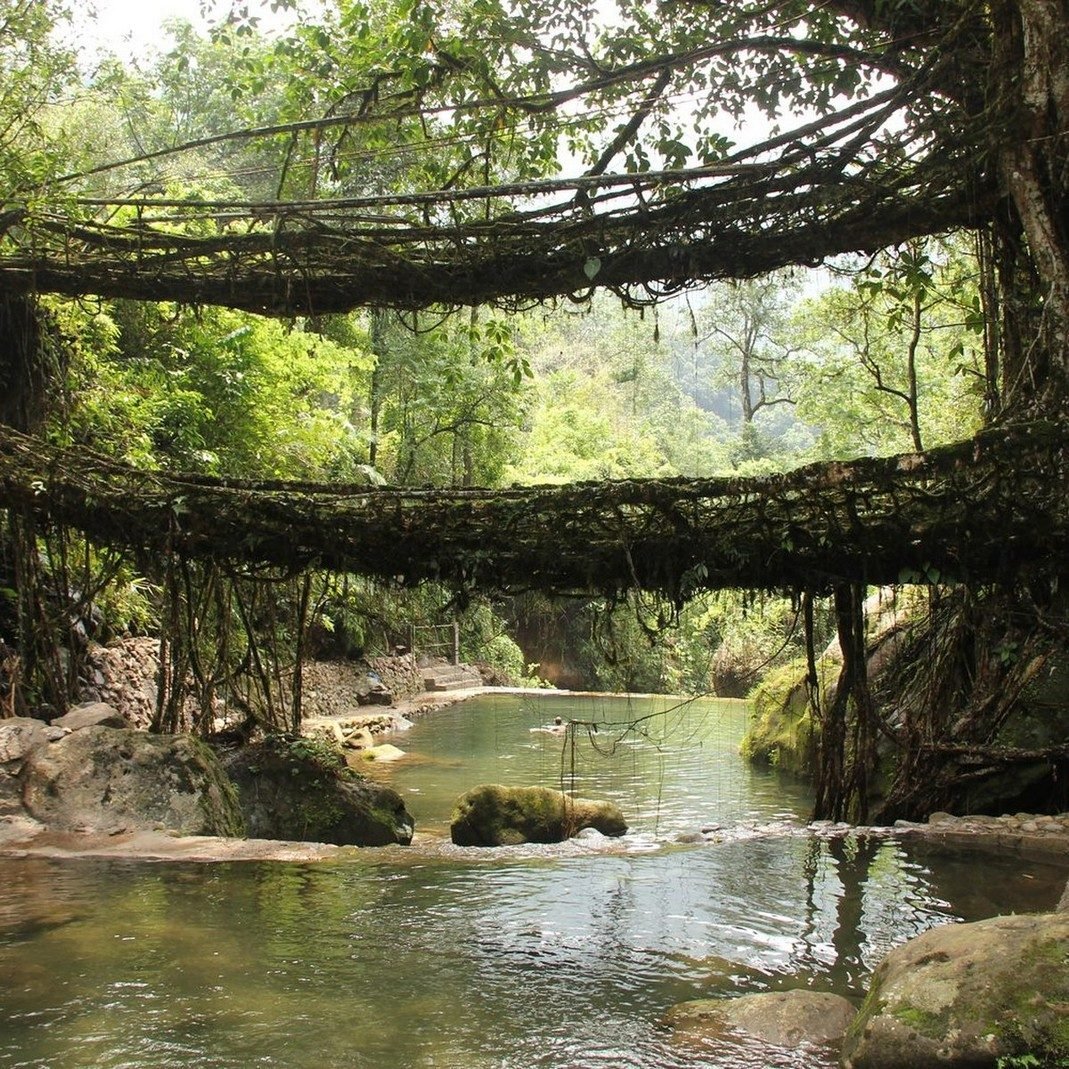
Photo: Arshiya Urveeja Bose / Wikimedia Commons (CC BY 2.0)
Uphill into the Clouds
The road from Guwahati to Shillong climbs out of the Brahmaputra's heat into weather with a completely different temperament, and the state's name announces the change honestly: Meghalaya, coined at statehood in 1972, means 'the abode of clouds', and the clouds treat the title as a lease. These hills (the Khasi, Jaintia and Garo ranges) stand as the first wall the Bay of Bengal's monsoon meets after its run over the Bangladesh plains, and the collision produces the wettest inhabited places on the planet: Mawsynram and Sohra (Cherrapunji), a few kilometres apart on the southern scarp, trade the world rainfall record between them, with Sohra's legendary years measuring rain not in millimetres but in storeys. My shared taxi crossed Umiam lake's fjord-blue arms in and out of drifting mist, and the driver, a Khasi gentleman with gospel music on the stereo and firm views on Assamese driving, offered the state's weather philosophy at the viewpoint: 'People ask when the rain will stop. Wrong question. The rain lives here. We are the visitors. Buy a good umbrella and stop asking.'
The rain lives here. We are the visitors. Buy a good umbrella and stop asking.From the chapter
The Hill Capital and the Mother's House
Shillong wears its inheritance lightly: pine ridges, colonial cottages with tin roofs and dahlia gardens, church spires in most directions, the Khasi hills took to Christianity in the colonial era while keeping their older faith's bones, and a music culture so dense the town is routinely called India's rock capital: choirs, garage bands, a Bob Dylan café, and buskers on Police Bazar's evening streets performing to crowds that actually listen. At the Lewduh bazaar, one of the largest traditional markets in the Northeast, I got my first real lesson in what makes Khasi society structurally unlike almost anywhere else on Earth. The market's commanding officers were women, not as exception but as system: stall after stall of formidable Kong (the honorific every market woman carries), managing produce, credit and conversation with total authority. The Khasi, Jaintia and Garo peoples are among the world's largest surviving matrilineal societies: descent and clan pass through the mother, children carry the mother's surname, and ancestral property flows to the khadduh, the youngest daughter, who inherits the family house along with its heaviest duty: the care of parents, and the keeping of the clan's hearth, to which every member has a right of return.
The chapter continues in the book…
- AnticipationUphill into the Clouds
- ArrivalThe Hill Capital and the Mother's House
- ExplorationThe Edge of the Rain
- DiscoveryThe Bridges That Are Alive
- The TableSmoke, Sesame and the Kwai
- Traveller's NotebookMeghalaya Essentials
- FarewellPlanted, Not Built
Meghalaya, from the road

Read Chapter 31 in full
The complete Meghalaya chapter — with when to go, getting around, what things cost, what to eat and how to travel responsibly — is in 28 Shades of India.